
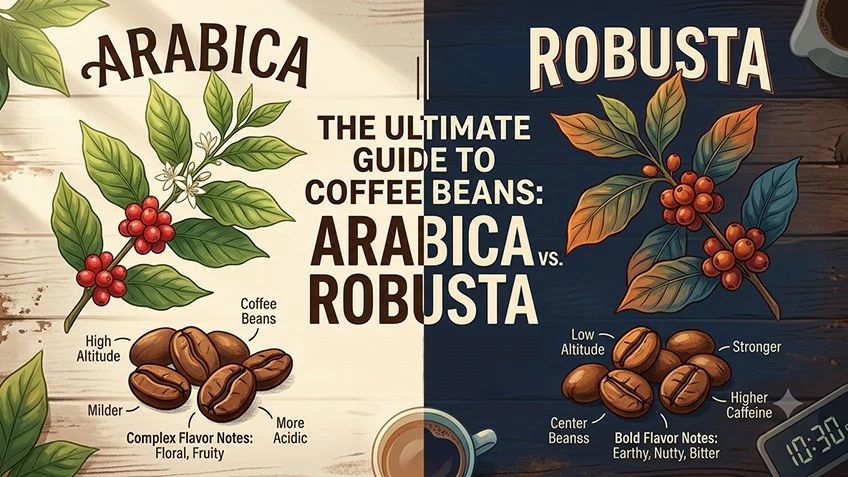
The morning ritual begins the same way for millions: the hiss of an espresso machine, the gurgle of a pour-over, the comforting drip of a beloved coffee maker. But before that first transformative sip, there’s a question most coffee drinkers never ask: What’s actually in my cup?
The answer lies in two species that dominate the world’s coffee landscape—Arabica and Robusta. Together, they account for virtually all commercially grown coffee, yet they’re as different as night and day. Understanding these beans isn’t just coffee snobbery; it’s the key to unlocking flavors you didn’t know existed and finding your perfect brew.
The Tale of Two Beans: Origins and Cultivation
Coffee’s story begins in the ancient forests of Ethiopia, where Arabica (Coffea arabica) first grew wild in the highlands. Legend tells of Kaldi, a goat herder who noticed his animals dancing after eating mysterious red berries. Whether myth or truth, Arabica became the world’s first cultivated coffee species, spreading from Ethiopia to Yemen, then conquering the globe.
Robusta (Coffea canephora), meanwhile, originated in the lowland forests of central and western sub-Saharan Africa. Discovered much later as a commercial crop, it didn’t gain serious traction until the late 19th century when coffee leaf rust devastated Arabica plantations across Asia. Robusta’s natural resistance made it the hero of desperate farmers—and it’s been fighting for respect ever since.
Today, Arabica commands roughly 60-70% of global production, while Robusta claims the remaining 30-40%. But these numbers don’t tell the whole story.
Growing Conditions: Where They Thrive
Arabica is the prima donna of coffee. It demands high altitude—typically 600 to 2,000 meters above sea level—where temperatures hover between 15°C and 24°C. These beans crave consistent rainfall, rich soil, and shade from harsh sun. They’re vulnerable to pests, diseases, and temperature fluctuations. Growing Arabica is like raising orchids: rewarding, but demanding.
Robusta, true to its name, is the workhorse. It flourishes at lower elevations (sea level to 800 meters), tolerates heat up to 30°C, and shrugs off diseases that would kill Arabica plants. It produces higher yields, grows faster, and asks for less pampering. If Arabica is an orchid, Robusta is a dandelion—thriving where others struggle.
This fundamental difference in cultivation affects everything from price to flavor to the communities that grow them.
Flavor Profile: The Taste Test That Matters
Close your eyes and imagine the most exquisite coffee you’ve ever tasted—bright, complex, perhaps with notes of berries, chocolate, or jasmine. You were almost certainly drinking Arabica.
Arabica: Complexity in a Cup
Arabica offers a symphony of flavors. Depending on origin, processing, and roast, you might detect:
- Bright acidity reminiscent of citrus, apple, or wine
- Sweetness ranging from caramel to brown sugar to tropical fruit
- Floral notes like jasmine or honeysuckle
- Nutty undertones of almond or hazelnut
- Chocolate notes from milk to dark
The acidity in Arabica isn’t harsh—it’s vibrant, like the snap you get from a crisp apple. The body tends to be lighter to medium, with a smooth, sometimes almost tea-like quality. Each origin tells a different story: Ethiopian beans might burst with blueberry brightness, while Colombian beans offer balanced sweetness and nuttiness.

Robusta: Bold and Unapologetic
Robusta doesn’t seduce—it announces itself. The flavor profile is:
- Earthy, woody, and sometimes grain-like
- Nutty, often with peanut characteristics
- Bitter, with a sharp edge
- Full-bodied and heavy on the palate
- Occasionally rubbery or harsh in lower grades
That bitterness isn’t a flaw; it’s chemistry. Robusta contains nearly twice the caffeine of Arabica (2.7% versus 1.5%), and caffeine tastes bitter. It also has about 60% more chlorogenic acids, contributing to its assertive flavor.
But here’s what Robusta advocates know: when grown and processed with care, Robusta can deliver a powerful, chocolatey, full-bodied experience. Fine Robustas from India or Brazil showcase nutty sweetness and a crema-producing richness that espresso lovers crave.
Chemical Composition: Science in the Bean
The flavor difference isn’t subjective—it’s molecular.
Caffeine Content
Robusta’s higher caffeine acts as a natural pesticide, explaining its disease resistance. For drinkers, this means a more intense jolt. A cup of Robusta-heavy coffee can deliver nearly double the caffeine punch of pure Arabica.
Sugar and Lipids
Arabica contains almost twice the sugars of Robusta (6-9% versus 3-7%), contributing to its inherent sweetness and caramelization potential during roasting. It also has 60% more lipids, creating those delicate aromatic oils that produce complex flavors.
Chlorogenic Acids
Robusta’s higher chlorogenic acid content (7-10% versus 5.5-8% in Arabica) contributes to bitterness but also offers potential health benefits, including antioxidant properties.
These chemical differences mean you’re not just choosing a flavor preference—you’re selecting an entirely different botanical experience.
Price Point: Why Your Wallet Feels the Difference
Walk into a specialty coffee shop, and you’ll notice Arabica beans command premium prices—sometimes double or triple Robusta’s cost. Why?
Production Costs
Arabica’s demanding growing conditions mean lower yields per hectare, more careful cultivation, and higher labor costs. The plants take longer to mature and produce less coffee per tree. Harvesting often requires hand-picking to select only ripe cherries, adding labor expenses.
Robusta’s resilience translates to economics: higher yields, mechanical harvesting potential, less crop loss to disease, and lower altitude land costs.
Market Perception
Specialty coffee culture has elevated Arabica to premium status. Third-wave coffee shops rarely feature Robusta, and marketing often positions Arabica as inherently superior. This demand drives prices higher.
Currently, Arabica trades at roughly $2-4 per pound wholesale, while Robusta hovers around $1-2 per pound. For consumers, this means a bag of premium Arabica can cost $15-25, while Robusta-heavy blends might run $8-12.
Best Uses: Matching Bean to Brew
Understanding these beans means knowing when to deploy each.
Arabica Excels In:
- Pour-over and drip coffee: The brewing method highlights its nuanced flavors and bright acidity
- Single-origin offerings: Showcasing terroir and regional characteristics
- Light to medium roasts: Preserving delicate flavor notes
- Coffee tastings: Offering complexity for discerning palates
Robusta Shines In:
- Espresso blends: Adding body, crema, and caffeine punch (many Italian espressos contain 10-30% Robusta)
- Vietnamese coffee: Traditional robusta-forward brewing with sweetened condensed milk
- Instant coffee: Robusta’s strong flavor survives the processing
- Budget-friendly daily drivers: Delivering caffeine and boldness economically
Many commercial blends combine both: Arabica for complexity and smoothness, Robusta for body, crema, and cost management. A 70/30 or 80/20 Arabica-Robusta blend can offer the best of both worlds.
Quality Spectrum: Not All Beans Are Created Equal
Here’s the truth specialty roasters won’t always advertise: not all Arabica is excellent, and not all Robusta is inferior.
The Arabica Range
Commodity-grade Arabica, mass-produced and carelessly processed, can taste flat, sour, or harsh. Specialty-grade Arabica (scoring 80+ on the 100-point scale), meticulously grown and processed, reveals coffee’s full potential.
The Robusta Renaissance
Fine Robustas, particularly from Indian estates or carefully selected Brazilian and Vietnamese farms, are gaining recognition. When grown at higher elevations for Robusta (up to 800m), harvested selectively, and processed with care, these beans deliver chocolatey richness without harsh bitterness.
The specialty coffee industry is beginning to recognize exceptional Robustas, though they remain niche.
Making Your Choice: Which Bean Is Right for You?
There’s no universally “better” bean—only better choices for your palate and purpose.
Choose Arabica if you:
- Appreciate nuanced, complex flavors
- Enjoy bright acidity and sweetness
- Prefer lighter bodies and delicate aromatics
- Want to explore single-origin coffees
- Are willing to pay premium prices
Choose Robusta (or blends) if you:
- Crave bold, full-bodied coffee
- Need maximum caffeine efficiency
- Make espresso and want luxurious crema
- Appreciate earthy, nutty profiles
- Seek value in your daily coffee
Consider blends if you:
- Want balanced flavor with body
- Enjoy espresso’s complexity with strength
- Appreciate both brightness and boldness
- Desire consistency at moderate prices
The Final Sip: Beyond the Binary
The Arabica versus Robusta debate isn’t about declaring a winner—it’s about understanding what’s in your cup and why it matters. Arabica offers elegance and complexity; Robusta delivers strength and resilience. Both have earned their place in coffee culture.
As you stand before the coffee aisle or specialty roaster tomorrow, you’ll now see beyond the marketing. You’ll know that the $22 Ethiopian Yirgacheffe represents Arabica at its floral, fruit-forward peak. You’ll understand why that Italian espresso blend includes Robusta for its creamy backbone. You’ll recognize that your preference isn’t right or wrong—it’s simply yours.
The best coffee isn’t defined by species alone. It’s defined by cultivation care, processing precision, roasting skill, and brewing technique. A mediocre Arabica will always disappoint, while an exceptional Robusta might surprise you.
So explore both. Taste single-origin Arabicas from different regions. Try a quality Robusta or a thoughtful blend. Pay attention to what your palate tells you, not what coffee snobbery dictates.
Because in the end, the ultimate coffee is the one that makes you pause, close your eyes, and think, “Yes. This is exactly what I needed.”
That’s the real difference worth understanding.