
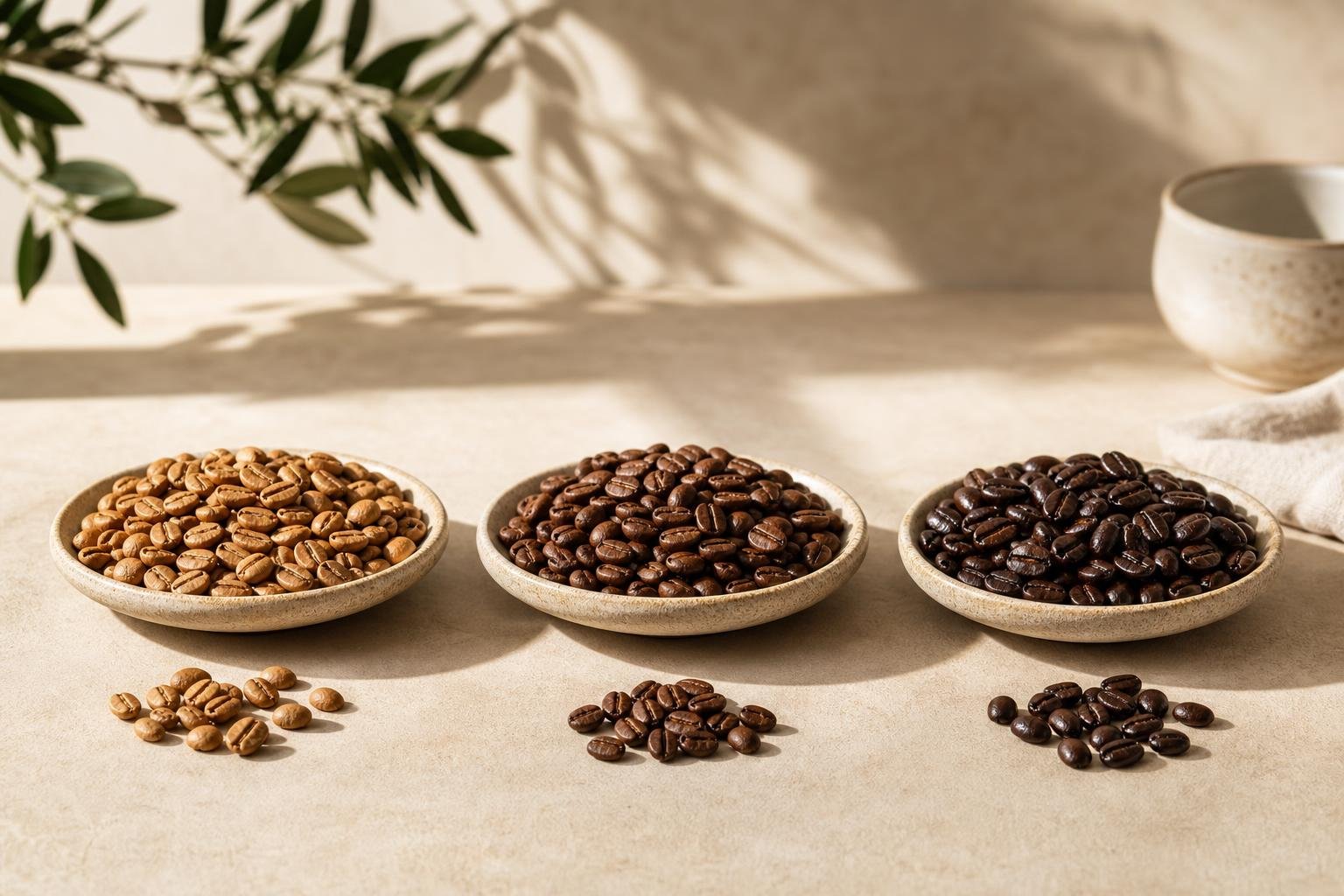
In simple terms, roast level describes how far green coffee beans have been heated and developed during roasting. Light roasts usually highlight more of the coffee’s origin and processing character, medium roasts often balance origin flavors with caramelized notes, and dark roasts tend to emphasize heavier, bittersweet roast flavors.
Roast level is not a quality ranking. Nor is it exactly the same as coffee strength, caffeine content, or brewing intensity. The best choice depends on the flavors you enjoy, the way you brew, and how much roast character you want in the cup.
What Do Coffee Roast Levels Mean?
Green coffee beans are dense, moist seeds. Roasting applies heat, drives off moisture, changes the bean’s structure, and triggers a series of chemical reactions that create the aromas and flavors associated with brewed coffee.
Roasters commonly describe the result as light, medium, or dark. However, these categories are practical consumer terms rather than perfectly universal technical standards. Roast labels can vary between roasters, countries, coffee origins, and measuring systems. Color is useful, but it does not tell the whole story: the roast profile, development time, bean variety, processing method, and brewing recipe also affect the final taste. ([sca.coffee](https://sca.coffee/sca-news/coffee-decoded-3-roast-level-consumers?utm_source=openai))
That means a “light roast” from one roaster may look or taste somewhat different from a “light roast” from another. Use the label as a starting point, then pay attention to the flavor description and brewing recommendations.
Light vs. Medium vs. Dark Roast at a Glance
| Roast level | Typical flavor direction | Acidity | Body | Roast character | Common brewing preferences |
|---|---|---|---|---|---|
| Light | Fruity, floral, citrus, tea-like, sweet | Often brighter or more noticeable | Light to medium | Low to moderate | Pour-over, batch brew, AeroPress, filter coffee |
| Medium | Caramel, nuts, chocolate, fruit, balanced sweetness | Moderate and rounded | Medium | Moderate | Drip coffee, pour-over, batch brew, some espresso |
| Dark | Dark chocolate, toasted sugar, spice, smoke, bittersweet flavors | Often lower in perceived acidity | Medium to heavy | Pronounced | French press, moka pot, espresso, drip coffee |
These are general tendencies, not guarantees. A naturally processed light roast may taste jammy and full-bodied, while a carefully developed dark roast may be less smoky than expected. Origin, processing, bean density, roast profile, grind size, water, and extraction all matter.
How Roasting Changes Coffee Beans
During roasting, coffee beans lose moisture and become larger, lighter, more porous, and more brittle. Heat also causes browning reactions that create many of the aromas associated with toasted bread, caramel, nuts, chocolate, and roasted food.
At a certain stage, pressure from water vapor and gases inside the bean causes an audible popping sound known as first crack. Roasters use this event as one reference point when deciding how much further to develop the coffee. Beans taken shortly after this stage are often described as light roasted, while longer development produces medium and dark roast profiles.
As roasting continues, more origin-specific compounds are transformed and more roast-derived aromas appear. The bean’s structure also becomes increasingly porous, which can influence how quickly water moves into the coffee during brewing. Research on roasting shows that moisture, density, acidity-related compounds, and other chemical properties change throughout the roast rather than at one simple, universal point. ([pmc.ncbi.nlm.nih.gov](https://pmc.ncbi.nlm.nih.gov/articles/PMC6365344/?utm_source=openai))
Light Roast Coffee: Flavor, Body, and Best Uses
Light roast coffee is typically roasted just far enough to develop the bean while preserving more of its origin character. Depending on the coffee, that may mean flavors reminiscent of berries, citrus, stone fruit, flowers, herbs, tea, or sugar cane.
Light roasts often have a brighter acidity and a lighter body than darker roasts. Here, acidity does not necessarily mean an unpleasant sour taste. In coffee, it can refer to a lively, refreshing quality similar to the tartness of citrus or the crispness of certain fruits.
Because the roast contributes fewer heavy, smoky flavors, light roasts can make differences between growing regions and processing methods easier to notice. A washed Ethiopian coffee, a naturally processed Brazilian coffee, and a honey-processed Costa Rican coffee may each show very different characteristics when roasted lightly.
Brewing light roast coffee
Light roasts can be less forgiving if a recipe does not extract enough flavor. They often respond well to relatively hot water, a fine enough grind, or a longer contact time, although the correct adjustment depends on the brewer and the coffee.
If a light roast tastes thin, sharp, grassy, or sour, it may be under-extracted. Try grinding slightly finer, using hotter water, or extending the brew time. If it tastes dry or harsh, move in the opposite direction.
Pour-over and other filter methods are popular choices because they can make a light roast’s fruit, floral notes, sweetness, and clarity easier to distinguish. That does not mean light roasts cannot work in a French press or espresso machine; they may simply require more recipe experimentation.
Medium Roast Coffee: The Flexible Middle Ground
Medium roast coffee aims for a balance between origin character and roast development. It may combine fruit or floral notes with flavors such as caramel, nuts, milk chocolate, baking spice, or toasted sugar.
For many coffee drinkers, medium roast is the most versatile category. It can offer more body and roast sweetness than a very light coffee without the stronger smoky or bittersweet character associated with a very dark roast.
Medium roast coffee works well in automatic drip machines, batch brewers, pour-over brewers, AeroPress, and some espresso recipes. It is also a common choice for households with different preferences because it can be enjoyable black or with milk.
Still, “medium” does not automatically mean mild or boring. A medium roast can be lively, complex, rich, or intensely aromatic depending on the bean and roast profile.
Dark Roast Coffee: Flavor, Body, and Best Uses
Dark roast coffee spends more time developing in the roaster. The resulting cup often emphasizes roast-derived flavors such as dark chocolate, toasted sugar, roasted nuts, spice, smoke, and bittersweet cocoa.
Dark roasts commonly have lower perceived acidity and a heavier body than light roasts. They can taste bold and intense, but that intensity is mainly a sensory impression created by roast flavor, bitterness, aroma, and body—not proof that the coffee is stronger in caffeine.
Very dark beans may appear shiny or oily because the structure has opened enough for oils to migrate toward the surface. Oily beans are not automatically fresher, higher quality, or more caffeinated. They are simply a sign of a relatively advanced roast, and some dark-roasted coffees may produce more residue in grinders and brewing equipment.
Brewing dark roast coffee
Dark roasts often extract readily and can become bitter, ashy, or drying when over-extracted. If a dark roast tastes harsh, try a slightly coarser grind, cooler water, a shorter brew time, or a lower coffee-to-water contact time.
Dark roasts are often used for espresso, moka pot coffee, French press, and milk-based drinks because their chocolatey and roasty flavors can remain noticeable when combined with milk. However, any roast can be used for espresso if the coffee is roasted and prepared with that brewing method in mind.
Does Dark Roast Have More Caffeine?
Usually, roast level makes a relatively small difference compared with the amount of coffee used and the brewing method.
Caffeine is relatively stable during roasting, although research findings can vary depending on the coffee, roast profile, measurement method, and brewing conditions. One study of brewed coffees found no statistically significant difference in caffeine concentration across light, medium, and dark roasts, while other research has reported differences under particular testing conditions. ([pmc.ncbi.nlm.nih.gov](https://pmc.ncbi.nlm.nih.gov/articles/PMC6365344/?utm_source=openai))
The way you measure coffee also matters:
- By weight: A light and dark roast dose with the same mass contains broadly similar amounts of caffeine, assuming the beans are otherwise comparable.
- By volume: Dark-roasted beans are less dense, so a scoop may contain a different mass of coffee than the same scoop of light-roasted beans.
- In the brewed cup: Dose, grind size, brew time, water volume, extraction, and serving size can have a much larger practical effect.
So the popular claim that light roast always has more caffeine—or that dark roast always has more—is too simplistic. If caffeine matters, measure your coffee by weight and consider the total dose and serving size.
Roast Level Is Not the Same as Coffee Strength
“Strong” can mean several different things. It might refer to a bold roast flavor, a bitter taste, a concentrated brew, or simply a coffee with a high caffeine content. These are not interchangeable.
A light roast can produce a strong, concentrated brew if you use a high dose and relatively little water. A dark roast can produce a weak cup if you use too little coffee or too much water. Similarly, dark roast often tastes more intense because of its smoky and bittersweet flavors, even when the drink is not more concentrated.
For clearer results, think of two separate questions:
- What flavor intensity do I want? This is strongly influenced by roast level.
- How concentrated do I want the drink? This is controlled mainly by the coffee-to-water ratio and brewing method.
How Roast Level Affects Brewing
Roast level is one variable in a much larger brewing equation. Use these suggestions as starting points rather than fixed rules:
- Light roast: Try hotter water, a slightly finer grind, or more contact time if the cup tastes sour or underdeveloped.
- Medium roast: Start with a balanced recipe and adjust for sweetness, acidity, and body.
- Dark roast: Consider slightly cooler water, a coarser grind, or less contact time if the coffee tastes bitter or smoky.
Grind size is especially important. A finer grind generally allows water to extract more quickly, while a coarser grind slows extraction. The right setting depends on the brewer, filter, dose, water, and coffee itself.
Do not assume that a bag marked “espresso roast” requires a particular machine. The term usually describes a roast style or flavor profile chosen with espresso in mind. Espresso is a brewing method, not a roast level.
How to Choose the Right Roast for Your Taste
Use this simple guide if you are unsure where to begin:
- Choose a light roast if you enjoy fruit, flowers, citrus, tea-like flavors, lively acidity, and a clearer sense of coffee origin.
- Choose a medium roast if you want balance, sweetness, moderate body, and a coffee that works across several brewing methods.
- Choose a dark roast if you prefer dark chocolate, toasted flavors, bittersweetness, heavier roast character, or coffee that stands up well to milk.
If you dislike bitterness, start with a light or medium roast that is described as sweet, fruity, or balanced. If you find light coffee too sharp or tea-like, try a medium roast rather than jumping immediately to the darkest option.
Remember that the same roast label can taste different from one roaster to another. A medium roast from a specialty roaster may taste much brighter and more fruit-forward than a supermarket medium roast designed for a traditional breakfast blend.
Common Roast-Level Terms and Label Confusion
You may also encounter terms such as City, Full City, French Roast, Italian Roast, breakfast roast, and espresso roast.
Some of these terms have historical associations with particular stages of roasting, but they are not used with complete consistency across the coffee industry. “French Roast” and “Italian Roast,” for example, generally suggest darker roasting, while “breakfast roast” may suggest a lighter or medium profile—but the exact meaning depends on the roaster.
Instead of relying on the name alone, look for information about flavor, roast color, brewing recommendations, and the roaster’s own description. A clear tasting note is often more useful than a dramatic label such as “bold” or “extra strong.”
Bottom Line: Which Roast Is Best?
There is no objectively best coffee roast. Light, medium, and dark roasts offer different ways of experiencing coffee.
Light roast coffee tends to emphasize origin character, brightness, and fruit or floral flavors. Medium roast coffee offers a flexible balance of sweetness, body, and roast development. Dark roast coffee focuses more on bittersweet, toasted, smoky, and chocolate-like flavors.
The best roast level is the one that matches your palate and brewing routine. Choose by flavor preference first, then adjust your grind, water, dose, and brew time to get the most from the beans.
Frequently Asked Questions
Is light roast stronger than dark roast?
Not necessarily. Light roast may taste brighter or more intense in acidity, while dark roast may taste bolder because of its smoky and bittersweet flavors. Brew strength depends mainly on the coffee-to-water ratio and extraction.
Does dark roast coffee have less caffeine?
Not reliably. Caffeine differences between roast levels are generally small and depend on how the coffee is measured and brewed. Dose, serving size, and brewing method usually matter more.
Is light roast coffee more acidic?
Light roast coffee often has more noticeable perceived acidity, but that does not mean every light roast is more acidic in every chemical or sensory measurement. Origin, processing, roast profile, and brewing all influence acidity.
Which roast is best for espresso?
Any roast can be used for espresso, but medium and dark roasts are common because their sweetness, body, chocolate, and roast flavors work well in a concentrated drink. Light-roast espresso can also be excellent when the recipe is adjusted carefully.
Which coffee roast is least bitter?
Light or medium roasts are often less bitter than very dark roasts, but bitterness also depends on extraction. A light roast brewed too hot or too long can taste bitter, while a well-brewed dark roast may taste smooth and balanced.
Can you use dark roast coffee in a pour-over?
Yes. Dark roast works well in a pour-over, although you may need to reduce extraction slightly with a coarser grind, cooler water, or a shorter brew time to avoid harshness.
What does medium roast coffee taste like?
Medium roast coffee often combines caramel, chocolate, nuts, fruit, and mild roast flavors. Its exact profile depends on the coffee’s origin, processing method, and the roaster’s development choices.
How can you tell if coffee is light or dark roasted?
Look at the beans’ color, surface, and flavor. Light beans are usually pale brown and dry-looking, while dark beans are deeper brown and may appear oily. Color can provide a clue, but the bag’s roast description and flavor notes are more reliable than appearance alone.