
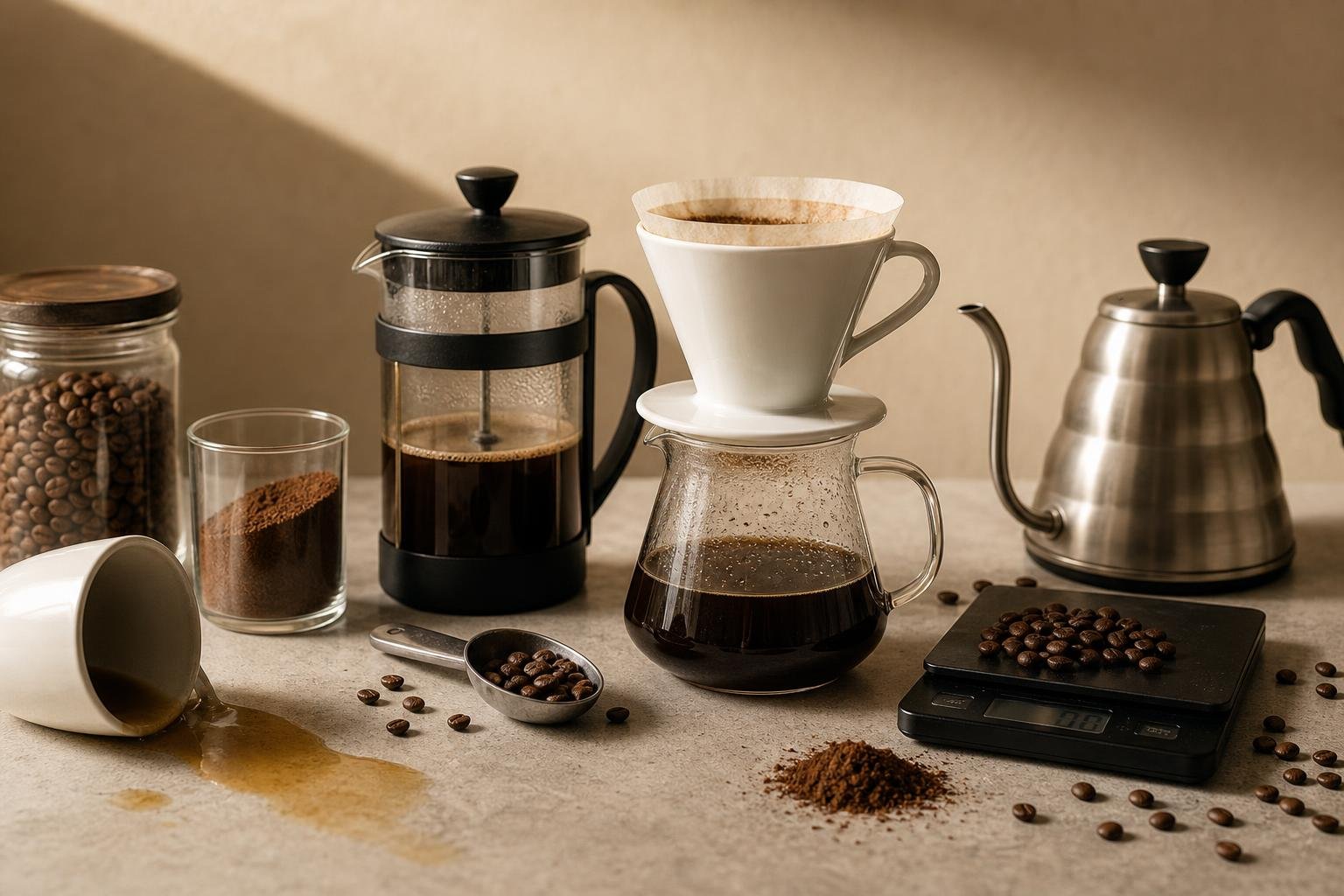
Great coffee at home does not require a complicated setup or a shelf full of expensive equipment. More often, the biggest improvements come from correcting a few basic coffee-making mistakes.
Freshness, grind size, coffee-to-water ratio, water quality, temperature and brew time all influence the final cup. Change one of those variables and your coffee may go from sweet and balanced to bitter, sour, weak or flat.
The good news is that most problems are easy to diagnose. Here are five common mistakes, the flavors they create and the simplest adjustments to try first.
1. Using stale coffee or storing beans poorly
Coffee does not spoil like fresh milk, but roasted beans gradually lose aroma and develop stale flavors. Oxygen is the main culprit, with heat, light and moisture also working against freshness.
Whole beans generally keep their flavor longer than pre-ground coffee because grinding exposes much more surface area to air. The Specialty Coffee Association notes that carbon dioxide can remain in whole beans for weeks but escapes much more quickly once coffee is ground.
How stale coffee tastes
- Flat or dull, even when the coffee is strong
- papery, cardboard-like or dusty flavors
- Weak aroma and little sweetness
- A brew that tastes lifeless rather than clearly bitter or sour
How to fix it
- Buy an amount of coffee you can use within a few weeks rather than storing a large bag for months.
- Choose whole beans where possible and grind just before brewing.
- Store beans in an airtight, opaque container in a cool, dry cupboard.
- Keep coffee away from the stove, direct sunlight, steam and strong odors.
- Avoid repeatedly opening a large container if you only brew one cup at a time.
Do not store everyday coffee beans in the refrigerator. Temperature changes can create condensation, and coffee can absorb odors from nearby foods. Freezing portions for longer-term storage can work in some situations, but for most home drinkers, buying smaller quantities and keeping them airtight is simpler.
2. Using the wrong grind size
Grind size controls how quickly water extracts flavor from coffee. Fine grounds have more surface area and generally extract faster. Coarse grounds extract more slowly.
That means grind size should match the brewing method. A grind that works well for a French press will usually be much too coarse for espresso, while an espresso grind can slow a filter brewer dramatically or produce a harsh, muddy cup.
Common starting points
| Brewing method | Broad starting point |
|---|---|
| French press | Coarse |
| Drip coffee maker | Medium |
| Pour-over | Medium to medium-fine |
| AeroPress | Medium-fine to medium, depending on the recipe |
| Espresso | Fine |
These are starting points, not universal settings. Grinder design, filter shape, coffee roast and brewing recipe all make a difference. Coffee ad Astra explains that finer particles extract more rapidly, while grind uniformity also affects how evenly water moves through the coffee bed.
How grind size affects flavor
- Too fine: The brew may taste bitter, harsh, dry or astringent. In a pour-over, the filter may clog and the brew may take too long.
- Too coarse: The coffee may taste sour, thin, sharp or watery because the water has not extracted enough flavor.
- Uneven: A mix of very fine and very coarse particles can create a cup that is both harsh and weak, with muddled flavor.
How to fix it
Adjust the grind gradually. If the coffee tastes sour or weak, try grinding slightly finer. If it tastes bitter, dry or overly heavy, try grinding slightly coarser. Change only a small amount at a time so you can tell whether the adjustment helped.
A burr grinder can make this process easier because it generally produces a more consistent particle size than a basic blade grinder. However, better technique with an ordinary grinder can still improve the cup.
3. Guessing the coffee-to-water ratio
Using “a scoop” of coffee is convenient, but scoops vary in size and ground coffee can have different densities. The result is an inconsistent brew from one day to the next.
A digital scale is one of the simplest useful tools for making better coffee because it lets you repeat a recipe accurately. A practical starting point for drip, pour-over and many immersion brews is around 1 gram of coffee for every 15–17 grams of water.
For example:
- 20 grams of coffee with 300 grams of water is approximately a 1:15 ratio.
- 20 grams of coffee with 340 grams of water is approximately a 1:17 ratio.
- 55 grams of coffee per litre of water is a commonly used SCA brewing reference for coffee brewer evaluations.
A smaller ratio, such as 1:15, produces a stronger-tasting beverage. A larger ratio, such as 1:17, produces a more diluted cup. Neither is automatically “correct”; your brewing method, coffee and preference all matter.
How to fix ratio problems
- If the coffee tastes weak but not especially sour, use more coffee or less water.
- If it tastes overly strong but reasonably balanced, use slightly less coffee or more water.
- If it tastes bitter, do not assume that adding more water is the only answer. Over-extraction, excessive heat or too fine a grind may be the real problem.
- Measure both coffee and water by weight when possible.
It is also worth checking how your brewer defines a “cup.” A coffee machine’s cup may be considerably smaller than a standard US measuring cup or a large travel mug.
4. Brewing with poor-quality or incorrectly heated water
Water makes up most of every cup of brewed coffee, so its flavor and mineral content matter. If your tap water smells strongly of chlorine, tastes metallic or leaves heavy scale in the kettle, it may also affect your coffee.
Water chemistry influences extraction. Very mineral-heavy water can produce a flat or harsh cup, while extremely low-mineral water may extract coffee differently and taste thin. The SCA describes water minerals and alkalinity as important factors in how coffee flavors are extracted and perceived. (https://sca.coffee/sca-news/25/issue-9/english/water-and-coffee-acidity-how-to-adapt-your-water-for-different-extraction-methods-25-magazine-issue-9-pxjby)
Temperature matters, too
Water that is too cool can produce under-extracted coffee: sour, sharp or weak. Water that is excessively hot, or held at high heat for too long, can contribute to harsh flavors, especially when combined with a fine grind or long brew time.
For most hot brewing methods, use water that is hot but not actively boiling. A broad starting range around 90–96°C (194–205°F) is reasonable, with adjustments based on the coffee and method. SCA brewing references commonly place coffee brewing in this general range, although the best temperature can vary.
How to fix water-related problems
- Use fresh, good-tasting cold water rather than water that has been sitting in the kettle overnight.
- If your tap water tastes unpleasant, try filtered water.
- Do not routinely use distilled water unless you are deliberately remineralizing it for brewing.
- Descale your kettle or coffee maker when mineral buildup becomes visible.
- If your brewer does not heat water sufficiently, preheating water may help, but follow the manufacturer’s instructions.
5. Ignoring brew time and uneven extraction
Brew time is not an independent target that guarantees good coffee. It is the result of several variables, including grind size, dose, water temperature, filter design, pouring and agitation.
Still, a brew that runs far too quickly or slowly is useful information. Water should contact the coffee evenly. If part of the coffee bed stays dry while another part receives most of the water, the cup may contain both under-extracted and over-extracted flavors.
Common causes of uneven brewing
- Pouring all the water in one spot
- Failing to wet the coffee grounds fully
- Using an inconsistent grind with many boulders and fines
- Pouring too aggressively and disturbing the coffee bed
- Allowing a pour-over filter to clog
- Using too little agitation in an immersion method
- Letting French press coffee sit far longer than intended
How to improve consistency
For pour-over coffee, wet the grounds evenly during the initial bloom, then pour steadily over the coffee bed rather than repeatedly hitting one small area. A gentle swirl can help settle the grounds, but excessive agitation may encourage fines to migrate and slow the brew.
For a French press, make sure all grounds are saturated, stir gently if your recipe calls for it and separate the brewed coffee from the grounds when the flavor reaches the level you like. For drip machines, check that the showerhead distributes water across the grounds and that the filter is seated correctly.
When adjusting a recipe, change grind size before obsessing over an exact brew time. A specific time can be useful for repeatability, but flavor is the better judge.
Quick troubleshooting guide by flavor
| Flavor problem | Likely causes | First adjustment |
|---|---|---|
| Bitter, harsh or dry | Grind too fine, brew too long, water too hot or uneven extraction | Grind slightly coarser or shorten contact time |
| Sour or sharp | Grind too coarse, brew too quickly or water too cool | Grind slightly finer or improve saturation |
| Weak or watery | Too little coffee, too much water or under-extraction | Use a little more coffee or tighten the ratio |
| Strong but balanced | The ratio is concentrated, not necessarily over-extracted | Add water after brewing or use a larger ratio next time |
| Flat or stale | Old beans, poor storage or unpleasant water | Use fresher coffee and clean-tasting water |
| Muddy or gritty | Too many fines, a clogged filter or a coarse filter | Check grind consistency and clean the brewer |
Flavor diagnosis is not always exact. Bitterness, weakness and dryness can have overlapping causes, so treat the table as a starting point rather than a laboratory test.
A simple better-coffee routine
- Use fresh coffee beans and store them in an airtight container.
- Grind shortly before brewing.
- Measure your coffee and water instead of relying on an inconsistent scoop.
- Start with a ratio around 1:15 to 1:17 for filter or immersion coffee.
- Use clean, good-tasting water at an appropriate brewing temperature.
- Choose a grind size suited to your brewer.
- Focus on even saturation and repeatable pouring or stirring.
- Change one variable at a time.
If you make several changes at once, you may get a better cup without knowing why. Adjusting one variable at a time turns each brew into a useful experiment—and helps you build a recipe that works reliably with your coffee and equipment.
Conclusion
The most common coffee-making mistakes are rarely caused by a lack of expensive equipment. Stale beans, an unsuitable grind, an inconsistent ratio, poor water and uneven brewing can all make a good coffee taste disappointing.
Start with the basics: fresh beans, a suitable grind, measured ingredients, clean hot water and consistent technique. Make small adjustments, taste the result and keep the changes that improve the cup.
FAQ
What is the most common mistake when making coffee?
Using an inconsistent coffee-to-water ratio is one of the most common mistakes because it makes every brew different. Stale coffee and the wrong grind size are also frequent causes of weak, bitter or flat-tasting coffee.
Why does my homemade coffee taste bitter?
Bitter coffee may be over-extracted because the grind is too fine, the brew time is too long or the water is too hot. Try grinding slightly coarser or reducing contact time before changing several other variables.
Why does my coffee taste weak and watery?
Weak coffee may contain too little coffee, too much water or grounds that are too coarse for the brewing method. Start by measuring your ingredients and try a slightly finer grind or a stronger ratio.
How much coffee should I use per cup?
A useful starting point is approximately 1 gram of coffee for every 15–17 grams of water. For a 300-gram brew, that means roughly 18–20 grams of coffee. Adjust the ratio to suit your preferred strength and brewing method.
What grind size should I use for coffee?
Use coarse grounds for a French press, medium grounds for many drip brewers, medium-fine grounds for many pour-over recipes and fine grounds for espresso. Treat these as starting points and adjust according to taste and brew flow.
Is boiling water bad for coffee?
Boiling water is not automatically disastrous, but water that is actively boiling can be too aggressive for some coffees and methods. Let it cool briefly or aim for roughly 90–96°C (194–205°F) for most hot brewing.
How long do coffee beans stay fresh?
Coffee freshness depends on the roast, packaging, storage and personal taste. Whole beans generally retain their aroma longer than ground coffee. Buy manageable quantities, keep the beans airtight and grind only what you need.
Should coffee beans be stored in the refrigerator?
Usually, no. Refrigerators expose coffee to moisture and food odors. Store beans in an airtight container in a cool, dry, dark cupboard. For longer-term storage, carefully portioned and sealed freezing may be considered, but everyday coffee is simplest to manage in the pantry.